How It Works
KaaS uses a compile-then-retrieve architecture. Instead of chunking raw text into a vector store (the typical RAG approach), it compiles your content through an LLM pipeline into structured, human-readable Markdown articles — then retrieves from those at query time.
The Two Phases
Phase 1: Compile
When you submit content (paste text, upload a file, or provide a URL), it enters a 4-stage pipeline:
Raw Content → Extract → Classify → Write → Index → Structured WikiEach stage is an LLM call that transforms the material further:
| Stage | What it does |
|---|---|
| Extract | Pulls out concepts, entities, decisions, and action items from raw text |
| Classify | Maps extracted items to existing wiki articles or marks them for creation |
| Write | Creates new articles or merges into existing ones (Markdown output) |
| Index | Updates the master-index and topic-indexes for retrieval navigation |
The result is a set of interlinked Markdown files — readable by humans, manageable with git, and structured for LLM retrieval.
Phase 2: Retrieve
When you ask a question, KaaS uses LLM-iterative retrieval (no embeddings, no vector database):
- Feed the
master-index.mdto the LLM as a navigation catalog - The LLM selects the most relevant wiki pages
- Read those pages in full and feed them as context
- Generate a cited answer via SSE streaming
This approach eliminates the noise of chunk-based retrieval — the LLM reads complete, well-structured articles rather than arbitrary text fragments.
Why Compile First?
| Compile-then-retrieve | Chunk-and-embed (naive RAG) |
|---|---|
| Structured, deduplicated articles | Raw chunks with redundancy |
| Human-readable output you can edit | Opaque vector store |
| LLM navigates a curated index | Similarity search on noisy embeddings |
| Context is a complete article | Context is a 512-token fragment |
| Zero embedding dependencies | Requires embedding model + vector DB |
Worker Acceleration
The compile phase is parallelized by a Go Worker Pool that manages concurrency, fault tolerance, and incremental processing:
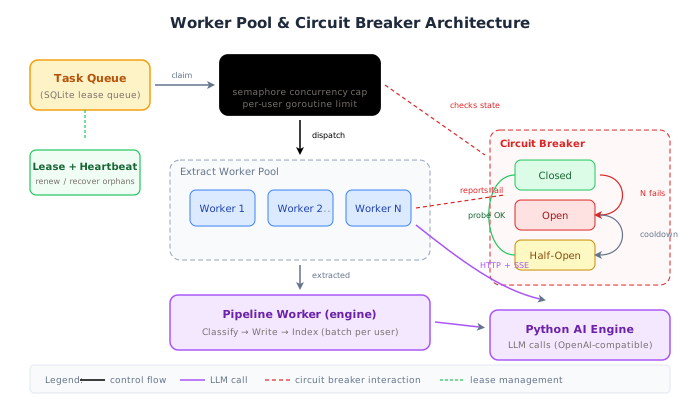
Key mechanisms:
- Dispatcher — semaphore-based concurrency control; per-user goroutine limit
- Extract Worker Pool — multiple parallel workers for the Extract stage (configurable via
extract_workers) - Pipeline Worker — batches Classify/Write/Index per user
- Circuit Breaker — halts LLM calls after N consecutive failures; auto-recovers via half-open probe after cooldown
- Lease + Heartbeat — prevents duplicate processing; recovers orphaned tasks after crashes
See Compile Pipeline for a detailed breakdown of each stage.