Introduction
The Problem
Knowledge inside organizations is scattered — across documents, meeting notes, emails, chat threads, and people's heads. When someone changes roles or leaves, the context they built up walks out with them. New team members spend weeks piecing it back together by asking the same questions that have already been answered dozens of times.
Traditional search tools only find documents; they don't distill understanding. You still have to read, cross-reference, and synthesize on your own.
The KaaS Approach
KaaS (Knowledge as a Service) takes a fundamentally different approach: compile-then-retrieve.
Instead of chunking raw text into a vector store and hoping similarity search returns something useful, KaaS runs your content through a 4-phase LLM compilation pipeline:
Raw Content → Extract → Classify → Write → Index → Structured Wiki- Extract — Pull out concepts, entities, decisions, and relationships from raw material.
- Classify — Determine which wiki articles each piece of knowledge belongs to.
- Write — Generate or merge human-readable Markdown articles with proper structure and cross-links.
- Index — Update a master index so the knowledge base is navigable and queryable.
The output is a plain-Markdown wiki you can read, edit, and manage with Git — not a black-box vector database.
KaaS vs Traditional RAG
| Traditional RAG | KaaS | |
|---|---|---|
| Processing | Chunk & embed raw text | Compile through LLM pipeline |
| Storage | Vector database (opaque) | Markdown wiki (human-readable) |
| Retrieval | Similarity search over chunks | LLM-iterative retrieval over structured articles |
| Output quality | Stitched-together fragments | Coherent, pre-synthesized articles |
| Maintainability | Re-embed on every change | Incremental compilation |
| Transparency | Black box | Git-managed, editable by humans |
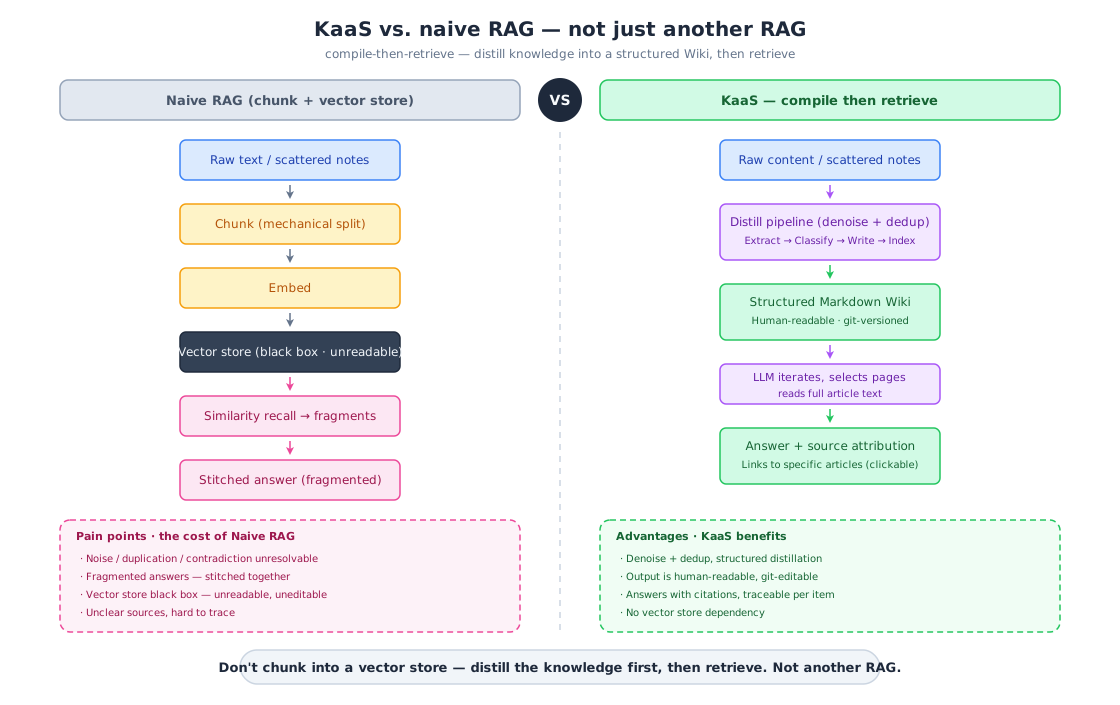
RAG answers queries by retrieving raw chunks and hoping the LLM can synthesize them on the fly. KaaS does the hard synthesis work at compile time, so retrieval returns pre-structured, high-quality articles — yielding more accurate and coherent answers.
Who Is This For
- Teams whose knowledge lives in scattered docs, transcripts, and tribal memory — and who want it compiled into a persistent, navigable wiki that survives personnel changes.
- Individuals who accumulate notes, bookmarks, and research across multiple sources and want them distilled into a structured personal knowledge base.
- Organizations tired of re-answering the same questions every time someone new joins.
- Developers who want a queryable knowledge base accessible via MCP from their coding agents (Claude Code, Codex, etc.).
Key Features
- 4-Phase Compile Pipeline — Extract concepts/entities/decisions, classify into articles, write/merge Markdown, update indexes.
- Incremental Compilation — Only recompiles new or changed content; existing articles are preserved and merged.
- Multiple Input Sources — Paste text, upload files, or provide URLs.
- Streaming Chat with Citations — Ask questions and get answers grounded in your wiki articles.
- MCP Access — Query the compiled wiki from any MCP-capable coding agent via a single
asktool. - Git-Friendly Output — All wiki articles are plain Markdown, versioned and diffable.
- Worker Acceleration — Concurrent pipeline workers with circuit breaker and lease recovery.
- OpenAI-Compatible — Works with any OpenAI-compatible LLM API (OpenAI, DeepSeek, Ollama, vLLM, Azure, etc.).
Next Steps
Ready to try it out? Head to the Quickstart guide to set up KaaS in under 5 minutes.