The Compile Pipeline
The compile pipeline transforms raw content into structured wiki articles through four sequential LLM stages. The Go backend orchestrates execution with concurrent workers; the Python AI engine (kb-ai) runs the actual LLM calls.
Pipeline Overview
┌─────────┐    ┌──────────┐    ┌───────┐    ┌───────┐
│ Extract │───▶│ Classify │───▶│ Write │───▶│ Index │
└─────────┘    └──────────┘    └───────┘    └───────┘
   parallel       sequential      sequential    sequential
The Extract stage runs in parallel across a worker pool. Once extraction completes for a batch, the remaining stages run sequentially per user within the Pipeline Worker.
Stage 1: Extract
Goal: Pull structured information out of raw text.
The Extract stage reads the submitted content and produces a structured extraction containing:
- Concepts and entities
- Decisions and rationale
- Action items and ownership
- Key facts and relationships
Extraction Strategies
| Strategy | When used | How it works |
|---|---|---|
chunked | Short-to-medium documents | Split into chunks; extract from each independently |
summarize | Long documents, transcripts | Summarize chunks with a cheaper model first, then extract from summaries |
auto | Default | Automatically picks chunked or summarize based on chunk count |
The summarize strategy is significantly cheaper for long content (meeting transcripts, large documents) because it uses a smaller model for the summarization pass before feeding condensed text to the extraction model.
Parallel Execution
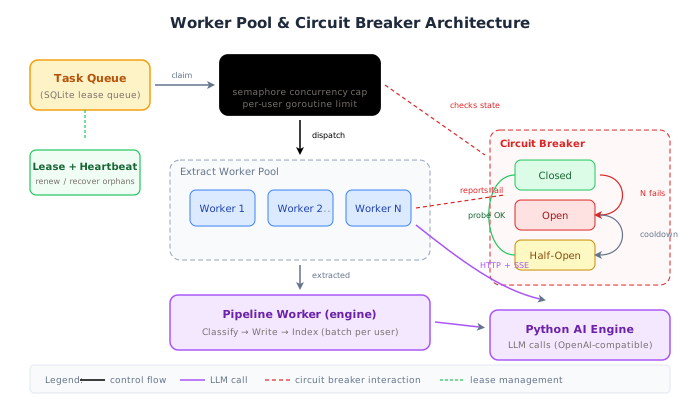
The Go Dispatcher assigns Extract tasks to a pool of workers (default: 4). Each worker independently calls the Python AI engine's /extract endpoint. Multiple documents are extracted concurrently, bounded by the semaphore in the Dispatcher.
Stage 2: Classify
Goal: Decide where each extracted item belongs in the wiki.
The Classify stage examines the extracted items and the current wiki structure, then:
- Maps items to existing wiki articles (for merging)
- Identifies items that need new articles
- Groups related items to avoid fragmentation
This stage reads the current master-index.md to understand existing wiki topology before making decisions.
Stage 3: Write
Goal: Produce or update Markdown articles.
Based on classification results, the Write stage either:
- Creates a new Markdown article from the extracted items
- Merges new information into an existing article, deduplicating and restructuring as needed
Output is clean Markdown with headings, lists, and interlinks — designed to be readable by both humans and LLMs.
Stage 4: Index
Goal: Keep navigation indexes current.
After articles are written, the Index stage updates:
master-index.md— the top-level catalog used by LLM retrieval to navigate the wiki- Topic indexes — per-topic groupings of related articles
- People stubs — brief reference pages for mentioned people
The master-index is the critical artifact: it serves as the entry point for all LLM-iterative retrieval queries.
Incremental Compilation
KaaS only recompiles new or changed content. When you submit material that overlaps with existing wiki content:
- Extract runs on the new submission only
- Classify identifies overlap with existing articles
- Write merges (not replaces) — preserving existing content while incorporating new information
- Index refreshes only affected entries
This means submitting 10 documents doesn't re-process the previous 100.
Concurrency & Acceleration
Dispatcher
The Dispatcher is the central coordinator:
- Polls the task queue on a configurable interval (
poll_interval_ms) - Claims tasks with a lease (prevents double-processing)
- Enforces a concurrency cap via Go channel-based semaphore
- Pauses claiming when the circuit breaker is open
Extract Worker Pool
Multiple goroutines process Extract tasks in parallel:
- Default concurrency: 4 workers (
extract_workersin config) - Each worker calls Python's
/extractendpoint via HTTP - Progress is reported via SSE streaming back to the frontend
Pipeline Worker
After extraction, a single Pipeline Worker per user batch runs the remaining stages:
- Classify → Write → Index executed sequentially
- Batches all pending extracted items for one user together
- Calls Python's
/pipeline-streamendpoint (SSE progress)
Circuit Breaker
Protects against LLM provider outages:
| Parameter | Default | Description |
|---|---|---|
cb_failure_threshold | 5 | Consecutive failures to trigger open state |
cb_cooldown_sec | 30 | Seconds before half-open probe |
State machine:
- Closed — normal operation; failures increment a counter
- Open — all calls rejected immediately; Dispatcher stops claiming tasks
- Half-Open — after cooldown, one probe request is allowed; success closes the breaker, failure re-opens it
Lease & Heartbeat
Each claimed task carries a lease with a timeout (lease_timeout_sec, default 300s). Workers periodically renew the lease via heartbeat. If a worker crashes:
- The lease expires
- The Dispatcher's
RecoverExpiredsweep re-enqueues the task - Another worker picks it up
This guarantees at-least-once processing without manual intervention.
Configuration Reference
All compile pipeline settings live in etc/kaas.toml under [worker]:
[worker]
extract_workers = 4          # Extract parallel worker count
pipeline_concurrency = 2     # Pipeline worker concurrency
poll_interval_ms = 1000      # Queue poll interval (ms)
lease_timeout_sec = 300      # Lease timeout before recovery (s)
cb_failure_threshold = 5     # Consecutive failures to open breaker
cb_cooldown_sec = 30         # Cooldown before half-open probe (s)